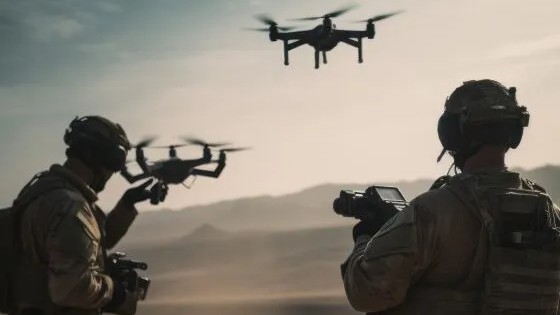
The Constraint Is Not Units. It Is the Retool.

Eric Schmidt says Russia has learned to innovate at Ukraine’s speed — and now it has the industrial capacity to do it at scale.
I think he is right about the direction, but there is an important part missing.
The real question is not how many drones Russia or Ukraine can build. It is how quickly they can change those drones when the other side figures out how to kill them.
That difference matters.
A Ukrainian commander told Schmidt this summer that his unit had stopped looking for targets. Not because there were no targets left, but because they had already found more than they had drones to hit.
That is probably the clearest description of Ukraine’s problem right now: there are targets, there are operators, there is intelligence — but not enough systems to act on all of it.
Schmidt uses this story to make a broader argument: a good-enough drone produced in the hundreds of thousands can be more useful than a brilliant system produced in the hundreds. Russia is now combining that industrial mass with faster adaptation, and the West needs to help Ukraine build at scale.
I agree with most of that.
But “scale” is not as simple as a production number.
The more interesting question is: what happens when the drone you are mass-producing stops being good enough?
What Schmidt says — and what the byline leaves out
Schmidt’s argument is straightforward.
For most of the war, Ukraine had one major advantage over Russia: speed.
Soldiers, engineers and small companies could build something, send it to the front, see what happened, and change it within weeks. Russia’s military bureaucracy was usually slower.
According to Schmidt, that advantage is now shrinking.
His clearest example is the interceptor drone.
Ukraine developed cheap interceptors that could hunt down piston-powered Shaheds. Russia responded with jet-powered Shaheds that are much harder to catch.
The same pattern applies elsewhere. A drone can be extremely effective when it first appears. Then the enemy changes frequencies, improves its jammer or fields a faster interceptor. Suddenly the same drone is much less useful.
That part of the argument makes sense.
But there are two things worth saying before we go further.
First, Schmidt’s role matters.
The Washington Post identifies him as the former CEO and chairman of Google and chairman of the Special Competitive Studies Project. It does not mention that he is also CEO of Swift Beat.
Swift Beat signed a memorandum with Ukraine’s Ministry of Defence in Denmark on July 3, 2025, covering the production of interceptor drones, quadcopters and strike systems. Zelensky described interceptors as the key priority and said the arrangement would provide them at cost.
That does not make Schmidt’s argument wrong.
But it does mean we should judge the argument on the evidence, not on his reputation. And the Post probably should have given readers that context.
Second, the idea that Ukraine needs more drones is hardly new.
In February 2024, Schmidt wrote in Foreign Affairs that Ukraine was losing the drone war. At the time, he cited Ukrainian estimates that Russia could produce or acquire around 100,000 drones a month, compared with roughly half that number for Ukraine.
So the argument about mass is more than two years old.
What is different now is the claim that Russia has also closed much of the innovation-speed gap.
That is the part worth testing.
And the interceptor-versus-jet-Geran story is a good place to start.
The useful example: interceptor vs. jet Geran
The timeline matters here.
The whole argument is about cycle time, so we need to look at how quickly each side moved.
The first jet-powered Shahed, the Iranian Shahed-238, was used in Ukraine as early as January 2024.
About a year later, in February 2025, Ukrainian military intelligence reported that Russia was setting up domestic production of its own version, the Geran-3, using a Chinese Telefly JT80 turbojet.
Ukraine recovered the first wreckage in June 2025.
The Geran-3 was roughly twice as fast as the Geran-2, reaching around 300–370 km/h depending on the source.
But the design had a problem.
Russia was still using essentially the same airframe as the piston-powered version. According to Ukrainian intelligence analysis cited by CSIS, the structure was not strong enough for the higher G-loads created by the increased speed.
In other words, Russia had pushed the old airframe about as far as it could go.
The answer was not another small modification.
It was a redesign.
The Geran-4, introduced in 2026, uses a more aerodynamic delta-shaped airframe with a reinforced structure and a higher-thrust Telefly turbojet. It can manoeuvre at roughly 300–400 km/h and reportedly reaches around 500 km/h at top speed.
Then came the Geran-5, which moves away from the delta design altogether and looks much more like a small cruise missile.
And in August 2026, Ukrainian intelligence reported that Russia had stopped producing the Geran-3 entirely.
The production lines had been reoriented toward the newer designs.
That sequence is more interesting than any single drone.
Look at it as an engineering programme.
In roughly eighteen months, Russia went from importing and adapting a foreign jet-powered design, to building a domestic derivative, discovering its structural limits, designing two new airframes and putting them into series production.
Then it shut down the intermediate model.
According to a Ukrainian Defence Intelligence assessment reported in August 2026, monthly production of the new jet variants was around 3,000 airframes, compared with roughly 2,800 piston-powered Geran-2s.
If that estimate is correct, Russia is already producing more jet Gerans than piston ones.
That number should still be treated as an estimate. It comes from a single intelligence assessment reported through secondary sources, and Alabuga’s real production capacity has been disputed for years.
But the broader point does not depend on getting the number exactly right.
Russia was willing to stop a production line making thousands of drones every month and retool it around a new design.
That is expensive.
It also requires the engineering and manufacturing systems to move together.
And that is exactly the capability Schmidt says Ukraine used to have through its decentralised networks.
Russia has now built something similar at industrial scale.
Why the number of drones is the wrong metric
Schmidt’s idea of hundreds of thousands of “good-enough” drones sounds like a numbers problem.
It is not.
The more useful question is: good enough for what?
The Geran programme gives us a pretty good answer.
CSIS has tracked the evolution of the Geran’s satellite-navigation antenna from a four-element Iranian system in 2022 to four-, eight-, twelve- and sixteen-element controlled-reception-pattern arrays by the end of 2025.
Chinese and Russian suppliers have been involved at different stages.
The reason for the upgrades is simple: Ukrainian electronic warfare kept getting better.
A four-element CRPA can null three sources of interference. An eight-element system can null seven.
In early 2026, a Ukrainian Air Force official told Reuters that electronic warfare could still neutralise close to half of the Gerans launched during some night attacks.
So the number leaving the factory is not the number that matters.
The useful number is the number that survives.
Russia has been buying back that survival rate step by step.
The same thing is happening with the control system.
From the summer of 2025, Gerans began appearing with Chinese XK-F358 mesh radios.
That changes what a swarm can do.
The drones can act as repeaters for one another, allowing operators in Russia to receive video and redirect drones much deeper inside Ukraine.
By early 2026, the system was reportedly being used across the Geran series.
One drone recovered in October 2025 had a satellite receiver that had been installed only seven days before it was shot down.
That tells us something about the speed of the production cycle.
From factory to launch: about a week.
None of this appears in a simple production number.
A fleet of 100,000 drones with four-element CRPAs and no useful data link is not the same weapon as a fleet of 100,000 drones with sixteen-element arrays and a mesh network.
Ukraine is fighting the second one.
And there is another important point here.
Russia is not necessarily trying to build the most advanced drone possible.
It does not need to.
It needs to build something that is good enough to get through the current Ukrainian countermeasures.
Once Ukraine finds a way to stop it, Russia changes the design.
That is the “good enough” approach.
And ironically, it is very similar to the approach that gave Ukrainian drone builders their advantage in the first place.
Ukraine is in the same loop — but the target keeps moving
The same logic works in reverse.
Ukrainian interceptor units reportedly destroyed more than 3,500 Russian UAVs of different types in May 2026.
That success is one of the reasons Russia started pushing harder into jet-powered Gerans.
But the problem is that the old interceptor is not automatically useful against the new target.
In July, a commander of one Ukrainian anti-aircraft drone unit told Militarnyi that intercepting jet Gerans was still not a systematic capability.
Successful interceptions depended heavily on operator skill and on the target losing speed while manoeuvring.
Cloud and fog make the problem even worse when detection is primarily visual.
The jet drone can simply get through.
The numbers show how quickly this problem is growing.
Between January and mid-June 2026, Russia used roughly 1,400 jet-powered drones against Ukraine, compared with around 180 in the comparable earlier period.
Syrskyi has said the jet-powered share could eventually reach half of Russia’s strike-drone use.
That changes the economics of the interceptor war.
An interceptor designed around the piston-powered Shahed is not “good enough” against a Geran-4 just because Ukraine has produced a lot of them.
More of the same interceptor will not solve the problem.
A different interceptor will.
The enemy gets a vote
And this is where the cycle gets harder.
Every time one side finds a solution, the other side gets a vote.
Ukraine has said that countering jet drones is now a priority.
Brave1 has supported work on interceptors capable of more than 450 km/h, including jet-powered designs, alongside low-cost surface-to-air missiles.
Ukrainian manufacturers have also acknowledged the obvious problem: faster interceptors cost more.
A propeller-driven interceptor costing a few thousand dollars can make sense against a Geran-2.
A jet interceptor against a Geran-4 is a different equation.
A cheap SAM is another option, but it changes the cost balance again.
The attractive economics that made interceptor drones so useful start to disappear as the Russian target gets faster.
And Russia is not waiting for that to happen.
Gerans have already been recovered carrying R-60 air-to-air missiles and Verba MANPADS rounds, apparently intended to engage interceptors and helicopters.
Within four months of the first R-60-equipped drone appearing, other drones were reportedly flying with decoy missiles designed to complicate threat assessment.
Think about what that means.
The drone being sent to destroy the interceptor may itself be able to fight back.
Add a rear-facing camera.
Add a mesh data link.
Add an air-to-air missile.
Now you are no longer dealing with a simple one-way attack drone.
And if Ukraine deploys a 450 km/h interceptor, Russia has several obvious responses: more speed, more altitude, more decoys, or a greater shift toward Geran-5-type airframes that create a different problem for air defence.
This is why the adaptation cycle matters so much.
Every Ukrainian countermeasure creates several Russian experiments.
Most will fail.
One or two will work well enough.
Those become the next standard.
Alabuga and Izhevsk are reportedly running different design approaches on the same basic platform.
That costs money and engineering capacity.
But it also gives Russia more shots at the next problem.
Where co-production actually fits
This is where I think Schmidt’s prescription needs more detail.
He is right that Ukraine cannot match Russia’s industrial capacity on its own.
He is also right that the West should move toward co-production rather than simply sending finished systems.
But there is a catch.
The Ukrainian advantage Schmidt is trying to preserve did not come from production capacity.
It came from proximity.
The operator, the engineer and the factory were close enough to each other that a problem seen on Monday could become a firmware change by Friday and a hardware change within a month.
That is why the system was fast.
The Russian Geran programme increasingly works in a similar way.
As the CSIS analysis points out, there is effectively no traditional programme office sitting in the middle of the loop.
That matters when we talk about moving production west.
A factory in Denmark or Texas can produce thousands of interceptors.
But if every design change has to pass through qualification, export controls, procurement rules and several layers of approval, the production line can become faster while the product itself becomes slower to adapt.
You can increase volume and still lose the war on cycle time.
Against an adversary willing to shut down a line producing thousands of drones a month in order to switch to a new airframe, that is a bad trade.
This is not an argument against co-production.
It is an argument for designing it properly.
Three things matter.
1. Retool latency
How long does it take to go from a confirmed change in the threat to a changed product leaving the factory?
Weeks can be competitive.
A quarter probably is not.
2. Front-to-factory distance
I do not mean kilometres.
I mean the number of decisions between the operator who sees a new Geran variant and the engineer who can change the system.
Every extra layer adds time.
Ukraine’s networks were fast partly because there were so few layers.
3. Component sovereignty
Russia’s system depends heavily on Chinese components: turbojets, CRPAs and mesh radios.
That is both an advantage and a vulnerability.
It gives Russia access to a large industrial ecosystem and helps it iterate quickly.
But it also creates dependencies.
A Western co-production programme that relies on a small number of critical foreign components can create the same problem.
And Western supply chains are not always good at replacing critical components quickly.
What actually matters
Schmidt is right about the direction.
Russia has clearly become much better at iterating the Geran.
And the evidence is stronger than his column makes it sound.
The transition from Geran-3 to Geran-4, the rapid CRPA upgrades and the rollout of mesh networking are not just claims from a press release.
They are visible in recovered wreckage and technical analysis.
Schmidt is also right about Ukraine’s immediate problem: production.
The story about commanders having more targets than drones is consistent with the wider picture.
But I think the conclusion needs to be slightly different.
Ukraine has not lost its ability to innovate.
The gap has simply become much smaller.
A new Ukrainian solution may now buy months rather than a year.
And Russia faces the same problem.
That is a change in the speed of the war.
It is not proof that one side has stopped being able to innovate.
The other missing piece is what we mean by “scale.”
Producing hundreds of thousands of the current interceptor will not solve the jet Geran if the interceptor was designed around the piston-powered version.
The capacity that matters is not just the capacity to manufacture a product.
It is the capacity to change that product before the enemy changes the problem again.
That requires a different kind of industrial base.
One built around fast feedback, short decision chains, flexible production lines and the ability to change components without restarting the entire programme.
That is much harder to measure than units per month.
But it may be the most important number in the war.
Three things I would watch this winter
First, the interception rate against Geran-4 and Geran-5 specifically.
Not the overall interception rate.
If Ukraine keeps shooting down large numbers of piston-powered Geran-2s, that tells us very little about whether the defence is keeping up with the new generation.
Second, whether a Ukrainian jet interceptor reaches series production before spring — and how much it costs.
The price matters almost as much as the speed.
Third, the Telefly turbojet supply chain.
If Russia really pushes jet-powered drones toward half of its strike-drone use, the availability of those engines could become one of the most important external constraints on the entire programme.
The lesson here is not that mass beats innovation.
It is simpler than that.
The side that can retool its mass faster gets to decide what “good enough” means next.
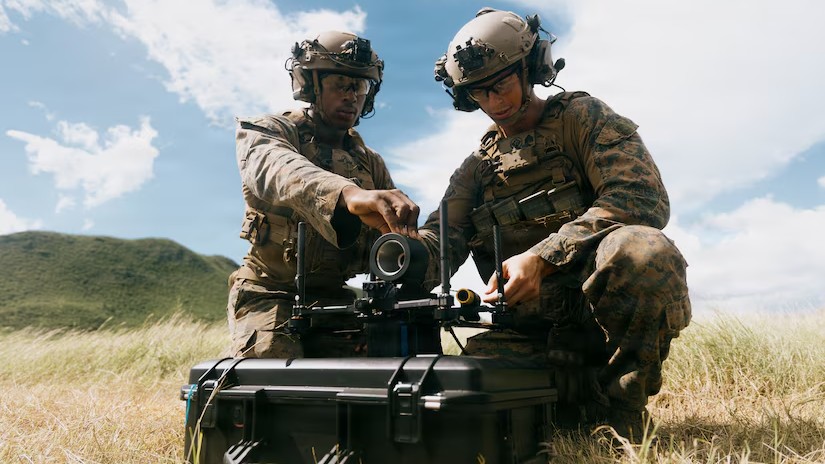
The US Marine Corps is turning the drone operator into a profession. The war may move faster than the curriculum
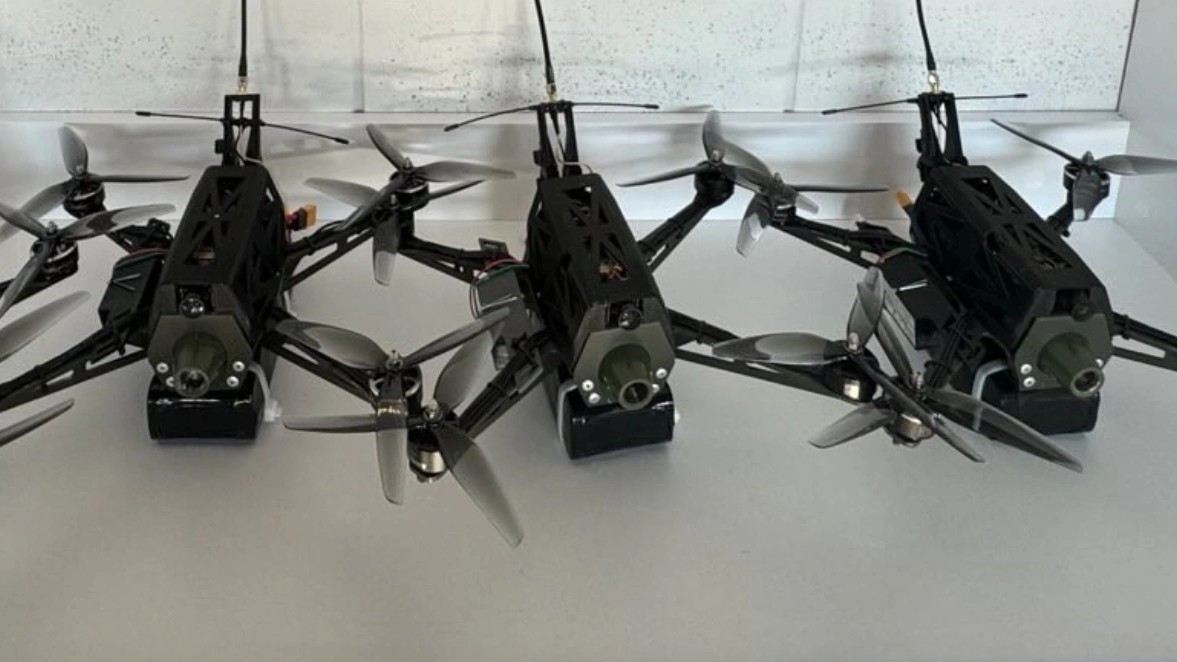
Drone autonomy is a ladder. The war sits on its lower rungs