Detect, Decide, Strike, in Software. What Ivy Mass Showed, and What It Did Not.
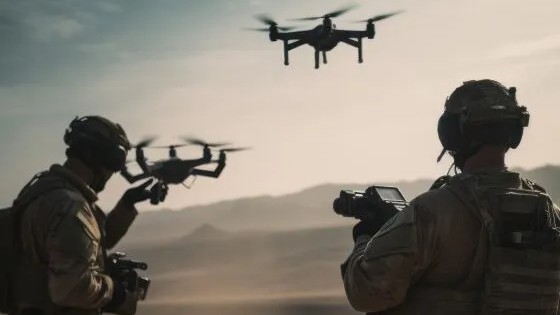
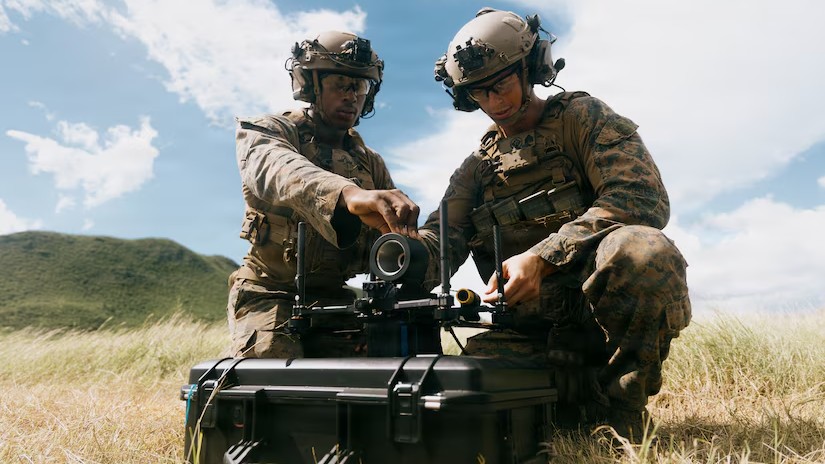
In May 2026, at a US Army exercise called Ivy Mass, one operator commanded a mixed group of reconnaissance drones and a Gremlin-X strike drone at the same time, with software handling a significant part of the coordination (Defense Express, June 2026; Palladyne AI, 16 June 2026). The scouts looked, the system passed targets, the strike drone was tasked through a shared command network. The loop this publication is named for, detect, decide, strike, was for a moment running partly in code.
That is the development worth taking seriously, and worth taking apart carefully, because the gap between what was shown and what was claimed is the whole story.
Key facts
- Ivy Mass is a US Army 4th Infantry Division multi-domain fire support and command exercise involving thousands of troops, held in May 2026.
- Palladyne AI, a US public company (NASDAQ PDYN), deployed its SwarmOS software and Gremlin-X mini bomber drone at the exercise.
- A single operator commanded a heterogeneous swarm of reconnaissance drones together with a Gremlin-X strike drone, with the swarm integrated into the Army's Next Generation Command and Control prototype, NGC2.
- Independent reporting states the drones were joined into one swarm, linked to NGC2 for real time data exchange, and that artificial intelligence handled a significant portion of the coordination.
- The setup is one human supervising a software coordinated swarm. This is human on the loop, not pilotless autonomy. Social media framing of a fully autonomous swarm under AI control overstates what was shown.
What was actually demonstrated
The software is SwarmOS, from Palladyne AI, a US public company. At Ivy Mass, a 4th Infantry Division fire support and command exercise involving thousands of troops, SwarmOS was integrated into the Army's Next Generation Command and Control prototype, known as NGC2, and a single operator directed a heterogeneous swarm of reconnaissance drones plus the company's Gremlin-X mini bomber (Palladyne AI, 16 June 2026). An independent account from Defense Express adds that the different drones were joined into one swarm, linked to NGC2 for real time data exchange, and that artificial intelligence handled a significant portion of the coordination (Defense Express, June 2026).
Read plainly, this is one human supervising a software coordinated swarm, with reconnaissance and strike fused into a single tasking loop. That is a real capability. It is also a narrower claim than the one travelling around social feeds, where the same event becomes a fully autonomous swarm under AI control. One operator is still in the loop. The autonomy is in the coordination, not in the absence of a person.
What a swarm OS does to the loop
The reason this matters is what it does to time and to span.
Time. The detect to strike sequence has always had a human in each link, looking, judging, deciding, cueing. A swarm OS collapses those links toward machine speed. The scout identifies, the system proposes, the striker is tasked, and the operator approves rather than performs. The loop runs faster because the human stops being the relay.
Span. One operator flying one drone is a fixed ratio. One operator supervising many drones breaks it. The same person now commands a formation, which is a force multiplier and a single point of strain at once.
Put together, the compression is the point. It is also the risk, because the thing being compressed is the interval in which a human decides whether to strike.
The question the compression forces
Speed up the loop and you squeeze the human judgement inside it. If the software finds, identifies, and cues a strike faster than a person can meaningfully weigh, the approval becomes a formality and the identification becomes the decision. Misidentification then scales at machine speed too. This is the doctrine crux of autonomous targeting, and a swarm OS does not solve it. It sharpens it. Where the human veto sits, and whether it stays real or turns nominal as the loop tightens, is the thing every military adopting this will have to answer in writing, not in a demo.
Demo and front are different places
A controlled exercise is not a contested front, and The Loop's standing rule applies here. Palladyne says SwarmOS ran in communications contested conditions, and its chief technology officer says the company cleared a fundamental technical threshold for battlefield autonomy (Palladyne AI, 16 June 2026). Those are the company's words, not an independent assessment, and Palladyne is a public company with investors reading the same release.
The Ukrainian front is the harder test, and it teaches the opposite of comfort. Autonomy there meets dense electronic warfare, satellite navigation denial, spoofing, terrain, and an enemy that adapts inside days. Swarm coordination that holds on a range in Colorado has not yet held over Pokrovsk. The useful question is not whether the kill chain can be automated. It clearly can, in parts, in good conditions. The question is how gracefully it degrades when the conditions are bad and the adversary is learning, which is the only condition that finally counts.
Wider context
None of this is a single breakthrough. The same direction is being pursued by the United States, Ukraine, the United Kingdom, and China, and Ukraine and Russia are already doing pieces of it at the front, one operator over several drones, reconnaissance paired to strike, autonomy added to beat jamming. What Ivy Mass marks is the institutional version, the swarm wrapped into formal command and control, NGC2 and the widely used ATAK interface, and into procurement. Palladyne was competitively selected under the Army's Disruptive Applications programme and will demonstrate next at larger exercises including Northern Strike 26-2, with more than 9,000 participants (UAS Weekly, June 2026). The race is shifting from whether to automate the loop to whose automation survives contact.
What to track next
Watch the bigger, messier exercises, Northern Strike 26-2 and the 4th Infantry Division events in Colorado and California. Performance there, against more contest and less script, will say more than the Ivy Mass release.
Watch where the human decision point lands as the loop compresses. The doctrine and the rules on autonomous identification and engagement will matter more than the airframes.
Watch whether the communications contested performance is ever validated independently, rather than asserted. On the front, electronic warfare is not a feature of the test. It is the test.
The Human Was in the Loop. The Verification Was Not.
The Constraint Is Not Units. It Is the Retool.