When EW Cannot Win, the Counter Is a Smart Gun. Ukraine Fielded One Against Fiber Drones.
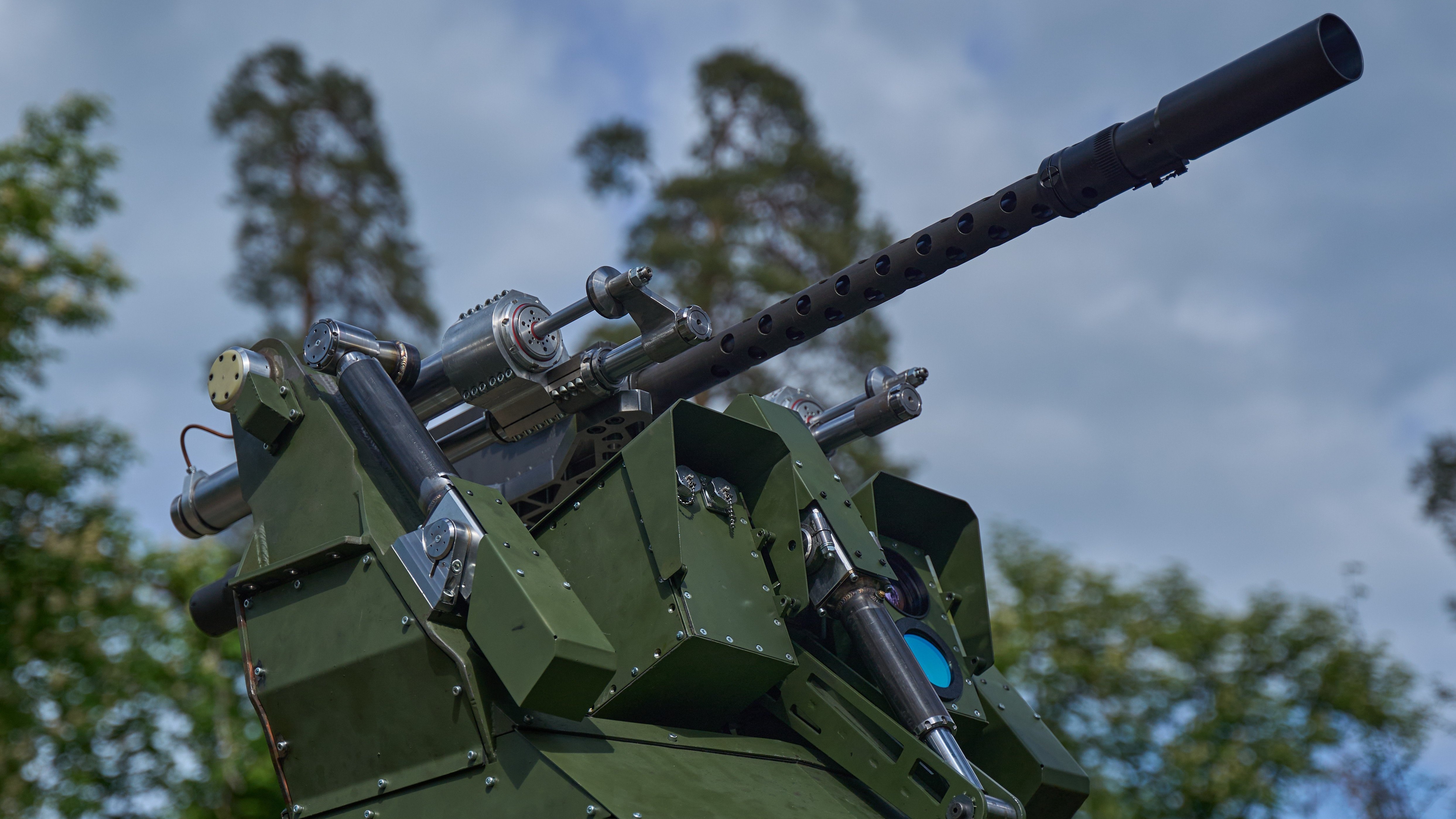
The Ukraine Ministry of Defence has announced that a "Kinetic Interception System" — which uses a 7.62mm machine gun on an AI-assisted turret to destroy fiber-optic drones — has been tested successfully during live fire exercises conducted by the K-2 brigade. According to sources, the Kinetic Interception System has already been deployed to more than 10 defense units.
Key facts
- Ukraine has fielded an AI powered gun turret that can intercept fiber optic drones, which are immune to electronic warfare because they use no radio link.
- The system was developed by UFORCE, a participant in the Brave1 defence cluster, and is built around a 7.62mm machine gun in the FN MAG and M240 family, with an effective range cited at up to 800 metres depending on the target.
- The artificial intelligence detects the drone, tracks it, and calculates its flight path. The operator confirms the engagement with a single button press.
- Detection and aiming are optical, not radio based, which is what allows the turret to engage a fiber drone that emits no signal to jam or track.
The Kinetic Interception System includes a 7.62mm FN-MAG/M240-style machine gun mounted on a turret. The machine gun is controlled using an advanced Artificial Intelligence system capable of detecting and tracking both airborne and ground-based targets. The system is able to operate within a maximum distance of approximately 800 meters, according to reports.
The AI component of the Kinetic Interception System detects the incoming drone; tracks it; and determines its trajectory. After the AI completes this task, a single button press by the operator engages the machine gun. Once engaged, the machine gun fires until either the drone is destroyed or ammunition is depleted.
Although the Kinetic Interception System is an active defense mechanism designed to protect against a specific type of threat (fiber-optic drones) and therefore should be classified as an anti-drone defense, some of the characteristics associated with traditional air-defense missiles remain. These include:
• Short-range capabilities • Point-defense operations • Limited coverage area due to narrow field of view • Multiple units required to provide comprehensive protection
However, unlike traditional air-defense systems utilizing expensive missiles, the Kinetic Interception System utilizes a relatively inexpensive method to neutralize threats. Each individual round fired from the machine gun can cost anywhere from $0.01-$1.00. In contrast, each individual round fired from many types of air-defense missiles can cost tens-of-thousands of dollars.
In addition, whereas the majority of modern electronic warfare systems utilize frequency-specific technologies (i.e., radar waves and communications frequencies), fiber-optic drones transmit data and receive commands via light through thin glass cables. Since fiber-optic drones do not emit radio signals, they are nearly impossible to disrupt electronically. Therefore, the primary means of disrupting fiber-optic drones involves physical destruction.
In summary, while the Kinetic Interception System provides limited protection due to its point-defense nature and relatively narrow field of view, it represents a viable option for defending against fiber-optic drones.
Unlike other forms of electronic warfare systems currently employed by Ukraine, the Kinetic Interception System requires little-to-no technical expertise to maintain or repair. While maintenance requirements may vary based upon usage patterns and environmental conditions, initial training for personnel assigned to operate this system would likely focus primarily on operating the machine gun and confirming engagements via the AI system rather than performing complex technical diagnostics or repairs.
As mentioned earlier, the Kinetic Interception System operates under manual oversight; however, this does create potential challenges related to how quickly operators become accustomed to making decisions rapidly in response to rapidly changing situations. The possibility exists that if sufficient numbers of these systems were to be deployed and utilized extensively, then even with manual confirmation of engagements, these could eventually transition into rapid-fire automatic responses without conscious consideration by the operator.
Regardless of future developments regarding automation and speed of operation for this technology, as long as a human remains in the loop prior to engaging targets with lethal force, then this meets all criteria as outlined in DoD Directive S-3600.1, Manual Control Requirements.
Additionally, since this technology serves as a complementary tool to other electronic warfare measures being implemented by Ukraine, this is another example demonstrating how multiple tools can be utilized simultaneously to achieve desired objectives — specifically in regards to defending against enemy drone attacks.
The lessons learned from Ukraine’s efforts to develop effective defenses against enemy drone attacks will undoubtedly serve as valuable insights for militaries worldwide. One critical lesson that will resonate throughout multiple branches of service relates to recognizing that electronic warfare alone is insufficient when dealing with enemy drones employing jam-resistant communication methods. Another important lesson is that combining affordable kinetic intercepts with advanced AI-powered targeting systems can help mitigate this threat effectively.
An additional aspect that should be tracked moving forward relates to the expansion and deployment of this technology. Specifically, what level of success will Ukraine experience in terms of deploying these systems in larger quantities? Additionally, what will be the cost-per-unit of production once mass production begins? Both questions will play significant roles in determining whether this technology will continue to be viewed as merely a prototype or if it will ultimately represent a deployable capability.
The Constraint Is Not Units. It Is the Retool.
A Russian jamming post shows why suppressed often means the drone is still flying