Watching Someone Else's War: How Ukraine Rewrote the Pentagon's Resupply Doctrine
Key facts
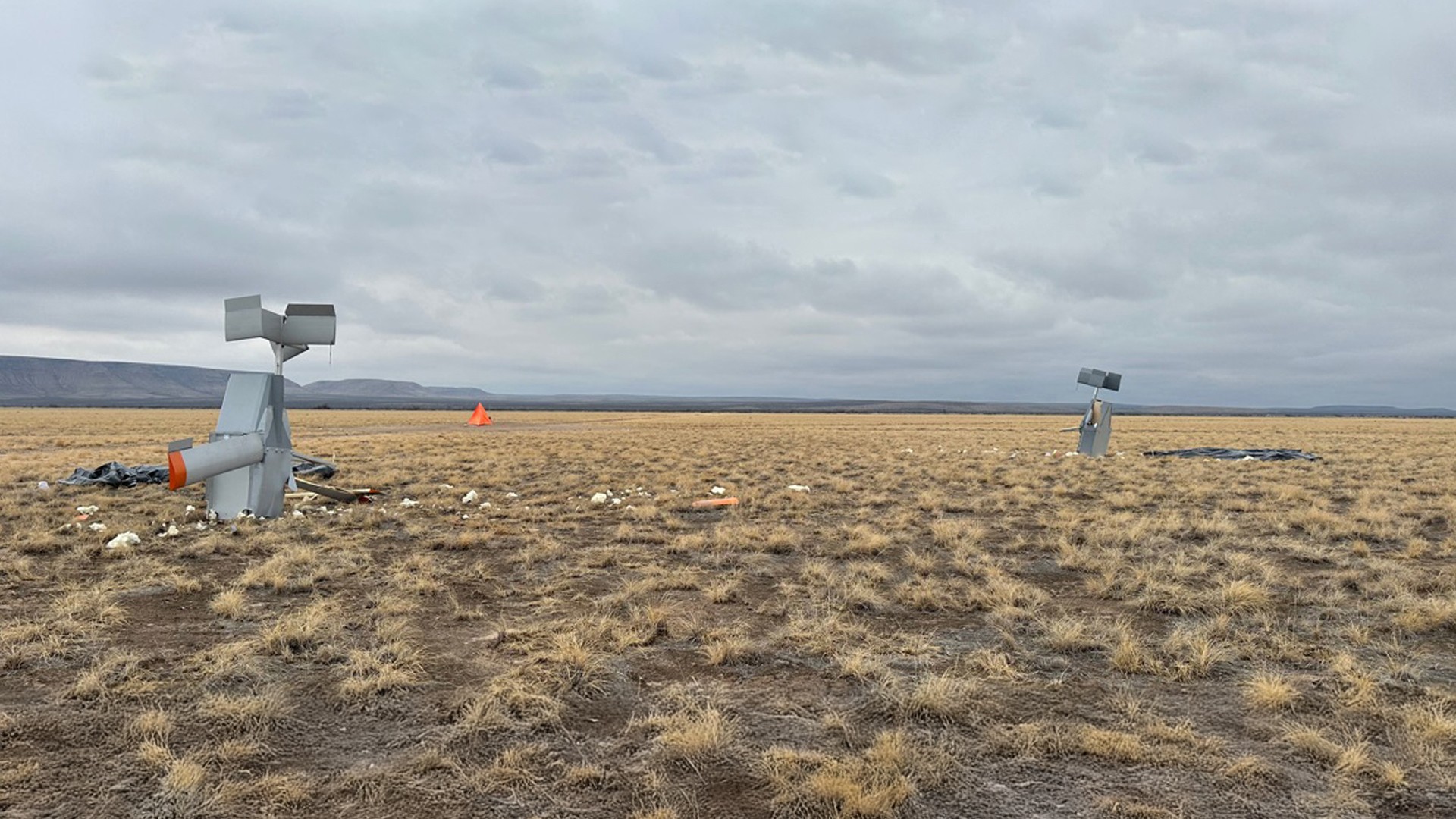
- Under 12 months, research to fielded. The Grasshopper went from research project to fielded US Air Force capability in under a year, per its developer - a pace defense acquisition almost never moves at.
- A doctrine reopened by someone else's war. US aerial resupply long assumed air superiority - transports flying unmolested to a drop zone. The Russia-Ukraine war broke that assumption on public video, and a NATO exercise this May was framed as a direct response: convoys get hit, helicopters get hit, cheap drones find vehicles on roads.
- Three lessons crossed over. Standoff is mandatory (the crewed transport never enters the threat zone); contested spectrum is the default (inertial nav, no reliance on GPS); expendability is a virtue (kept under $40,000 so loss is tolerable). The glider physically embodies all three.
- Cargo autonomy is a training ground for armed autonomy. A glider self-navigating through jamming carries the same enabling tech and institutional comfort with autonomy directly into weapons systems - the lower-stakes resupply mission normalizes delegating flight to machines.
- $40,000 is the start of the lesson, not the end. Ukraine's lesson is mass - hundreds of thousands of attritable units. A $40,000 glider is attritable next to a crewed aircraft but expensive next to a true consumable: doctrine absorbed expendability faster than manufacturing delivered the price point.
Under twelve months. That's how fast the Grasshopper cargo glider went from research project to fielded capability with the US Air Force, by the developer's own account - a pace that defense acquisition almost never moves at. The interesting question is not how. It is why now. The answer is that the United States spent three years watching a war it is not fighting, and rewrote a piece of its doctrine based on what that war taught about a problem it had considered solved: getting supplies the last mile.
A solved problem, reopened
For decades, American aerial resupply was a mature, almost routine capability. Cargo aircraft flew to a drop zone; parachutes did the rest. The assumption underneath was air superiority - that a transport plane could approach the delivery point without being shot down. That assumption held in Afghanistan and Iraq, where the US owned the sky.
The Russia-Ukraine war broke the assumption in full view. It demonstrated, at scale and on video, a battlefield where nothing on the ground moves safely within tens of kilometers of the line, and where the air over that zone is saturated with cheap sensors and cheaper munitions. A NATO exercise this May was described by one outlet covering it in almost confessional terms: three years of watching Russia and Ukraine has changed how the Pentagon thinks about resupply, because convoys get hit, helicopters get hit, and even a few-hundred-dollar drone can find a vehicle on a forest road. That is not a statement about Ukraine. It is the US military re-examining its own assumptions against someone else's casualties.
What specifically transferred
Three doctrinal lessons crossed over, and the glider is the physical expression of all three.
Standoff is mandatory, not optional. The Grasshopper's entire design premise is launching the supply far from where it lands - "standoff distance" in the language of its developers - so the expensive, crewed transport never enters the threatened airspace. This is the airlift equivalent of what Ukraine learned the hard way on the ground: the platform that delivers must not be the platform that gets exposed. The crewed aircraft stays back; the cheap autonomous thing goes in.
Contested spectrum is the default environment. The glider is built to navigate inertially, without relying on GPS, because the war demonstrated that satellite navigation cannot be assumed over a modern battlefield. Western systems designed in the air-superiority era often treated GPS as a given. The Ukrainian and Russian electronic-warfare duel - jamming and spoofing as constant background - retired that assumption, and the Grasshopper's navigation reflects the new baseline.
Expendability is a virtue. Perhaps the deepest shift. The Grasshopper is designed to be thrown away - "expendable," kept under $40,000 precisely so its loss is tolerable. That is a direct inheritance from a war where cheap, attritable systems consistently outperformed exquisite, expensive ones in survivability terms. A doctrine that once optimized for reusable, high-end airframes is learning to optimize for things cheap enough to lose - though, as we note below, $40,000 is only the beginning of that lesson, not its endpoint.
The trade-offs the doctrine is accepting
Doctrinal borrowing is not free, and the honest reading includes what the US is giving up.
Autonomy in place of judgment. A glider navigating itself to coordinates through a jammed environment is making its own way with no human on the stick. For cargo, the stakes of an error are lower than for a weapon - a misdelivered crate, not a misplaced strike - but the same enabling technologies and the same institutional comfort with autonomy carry directly into armed systems. The resupply mission is, among other things, a low-risk training ground for delegating flight to machines.
Cost that isn't cheap enough yet. The Ukrainian lesson is mass: hundreds of thousands of attritable units. A $40,000 glider is attritable by the standards of a crewed aircraft but expensive by the standards of a true consumable; the doctrine has absorbed the principle of expendability faster than the manufacturing base has delivered the price point that makes it real at scale.
A capability others can copy. Nothing about an autonomous expendable glider is uniquely American. The same logic that produced the Grasshopper is legible to any adversary watching the same war - and the architectures being sketched to defend rear areas against cargo drones will not distinguish between flags.
Where this sits in the loop
This is the loop operating at the level of doctrine rather than hardware - one military's battlefield adaptations propagating into another military's institutional assumptions, compressed by the fact that the lessons arrived as years of public video rather than as a classified after-action report. The US adapted to a war it watched; the next question is who watches the US adapt. The capability is replicable, the counter is foreseeable (the rear-area sensor-and-interceptor concept cuts directly against slow cargo platforms), and the cycle does not pause for the fact that Washington is a spectator rather than a combatant.
What to watch
Three indicators. First, whether the expendable-logistics concept spreads beyond special-operations niche use into conventional force structure - the test of whether this is a doctrinal shift or a boutique capability. Second, the price curve: whether the manufacturing base drives the glider toward genuine consumability or it stalls as a low-volume premium item. Third, the reverse transfer: whether US doctrinal investment in autonomous logistics begins flowing back toward Ukraine as systems or concepts - closing a loop that started with the US learning from Ukraine in the first place.
The US Marine Corps is turning the drone operator into a profession. The war may move faster than the curriculum
Drone autonomy is a ladder. The war sits on its lower rungs