The Machine Gun Did Not Disappear. It Moved Back Three Kilometres.
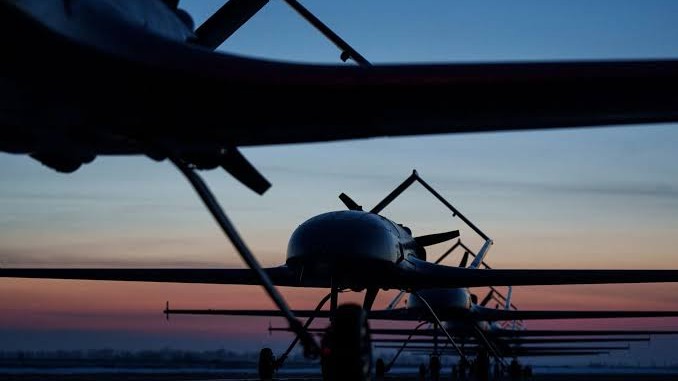
Drones now account for most hits along the line of contact, yet Ukraine's largest military charity still buys mortars, grenade launchers and Browning sights. A conversation with the man who runs its digital artillery programme shows what actually happened to infantry weapons: they kept their job and lost their place in the trench.
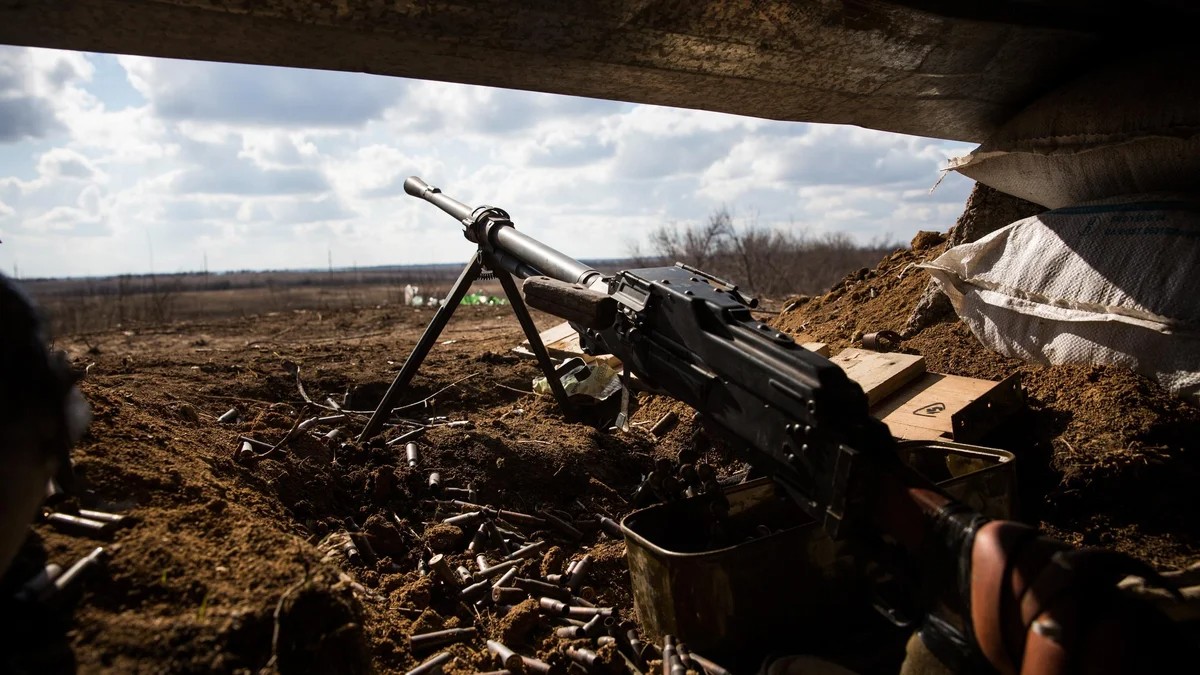
The wind was blowing at about ten metres per second from the Russian side. Six Russian soldiers were caught in the open, 4.5 kilometres from a Ukrainian heavy machine gun. The gunner could not see them. He was firing an M2 Browning from a covered position, laying the gun with a ballistic calculator, and he kept up suppressive fire in short bursts while an FPV drone flew out to them against the headwind. The drone took a little over twenty minutes to arrive. The gun held the group in place for twenty-six. Andrii Maruha, who heads the digital artillery programme at the Come Back Alive foundation and trained that gunner, told the story in the first episode of Militarnyi's new interview series, published on 26 October. His point was the arithmetic. Had the six men scattered into the tree line, the drone unit would have needed at least ten FPVs to find and kill them. Because they stayed in one hole, it needed one. The machine gun killed nobody and wounded nobody. It turned a ten-drone problem into a one-drone problem. The episode opened with a figure the host attributed to "various data": around 80 percent of hits along the line of contact are now made by drones. Nobody in the conversation disputed it. The interesting part is what Maruha described as the residue: where the remaining weapons went, who operates them now, and what they are for.
What the 80 percent counts
The drone share figures that circulate are not wrong, but they are not neutral either. Ukraine's Unmanned Systems Forces count casualties that their own pilots confirm on video in the Delta system. A Euromaidan Press report in October cited a figure of about 96 percent of Russian battlefield losses earlier in 2026. The figure comes from the same self-reporting chain. Earlier estimates of 70 to 80 percent of daily losses on both sides were published without a stated methodology. A drone records its own effect. A machine gun firing from a covered position at 4.5 kilometres does not, and a gun whose job is to hold a group in place for a drone produces no casualty of its own at all. In the story described above, the kill goes into the drone column, and so do the nine drones that were not needed. Any accounting system that credits only the final effector will undercount weapons whose contribution is time and suppression. That does not mean the drone share is small. It means the figure cannot be used as evidence that the other weapons stopped working.
What a crew-served weapon is, and what changed in it
Maruha's definition of crew-served infantry weapons is practical. A heavy machine gun like the M2 counts as crew-served because the whole unit carries it: two men on the gun, two on the tripod, ten on the ammunition. It belongs to the platoon or the company, not to a soldier. The 82 mm mortar is a company weapon, the 120 mm a battalion one. Historically these were the weapons closest to the enemy and the first to engage. The change he describes is not that these weapons disappeared. It is that they acquired a different fire mode. Since 2015 and 2016 his group has worked on ARMOR, a family of ballistic calculators that digitise old Soviet firing tables. A soldier selects a point on a map and gets a firing solution: how far to traverse the turret and how much elevation to set. In 2023, they implemented indirect fire from the M2 out to 5 kilometres. A Browning that used to sit on the forward line can now sit about three kilometres behind it, dug in and camouflaged, and engage targets the gunner cannot see. Maruha's line on why this works: nobody looks for a machine gun three and a half kilometres back. The same logic went into the MK-19 40 mm grenade launcher, which received sights for separate-laying indirect fire similar to the Soviet AGS, and into the SPG-9M recoilless gun, which some units in the south have fired with fragmentation rounds out to roughly six kilometres. Maruha said the SPG is rarely used now and short of ammunition. In 2014 a mortar officer computed the mean meteorological correction by hand from the met bulletin, averaging wind and temperature at 200, 400, 600 and 800 metres, reducing eight columns to two numbers, one correction for direction and one for range, and needed a couple of minutes to do it. After those two minutes, he said, the radio was already asking what was taking so long. A tablet does it in milliseconds. Maruha's phrase was that an artilleryman is a kind of engineer. What changed is that a crew-served infantry weapon can now be operated by someone who is not.
The battlefield problem: the weapon cannot reach the line
The constraint that reshaped these weapons is the depth of the kill zone. Maruha describes sectors where the distance between the sides is eight to twelve kilometres and it is simply not possible to carry a crew-served weapon forward. Either a ground robot delivers it, or only drones work that sector. RUSI's October 2025 paper on combined-arms manoeuvre puts the contested zone at about 15 kilometres deep. Where weapons do reach the line, they survive by not being seen. A mortar on the surface, in Maruha's words, does not live long now. The ones still working are dug deep, with a cover over the pit that is rolled off to fire and back on afterwards, while the crew goes into shelter. RUSI reports the same pattern: mortars and howitzers operate from closed positions dug into tree lines, fire missions rarely exceed ten rounds, and guns work alone rather than in batteries. The life expectancy of the weapon is the binding constraint, not its range. Maruha said that when his team collected data, very few grenade launchers reached 5,000 rounds, because FPVs found them first. Logistics decides the rest. If ammunition cannot be delivered to a position, there is no point in putting a heavy weapon there. One soldier said his unit has a Browning on position but does not fire it: it is the weapon of last resort, to be used once, at the moment it is needed most, because firing it earlier would reveal it. So the weapons survive where the front holds still. Maruha names the border with Russia in Sumy and Chernihiv regions and the Dnipro line in the south, where positions have stood for months and crews have had time to dig. In sectors like Kostiantynivka, where there is barely a line and the kill zone is wide, even the 60 mm mortar a soldier can carry on his back is not relevant. His summary: crew-served weapons are mainly a defensive tool. As soon as a unit has stood in one place for half a year and dug in, the heavy machine gun comes up and the mortar goes into the ground.
Where the drone falls short, and the gun does not
The case for keeping these weapons rests on the conditions in which drones are ineffective, such as rain and fog. RUSI's report on the third year of the war notes that FPVs do not function in bad weather, that 60 to 80 percent of Ukrainian FPVs fail to reach their target, and that artillery remained able to defend the front in poor weather and was generally more responsive. Assaults are often timed for bad weather precisely because it degrades both reconnaissance and strike drones. Maruha's version is more direct. A bullet arrives faster than a drone. A crew-served weapon is organic: it belongs to a specific unit and needs no request, no queue for a sortie, no working link. His advice from his own service was to plan as if no help will come, and to treat support as a bonus, because weather or electronic warfare can negate it. Taras Chmut, who heads Come Back Alive, made the same point in June when the foundation handed over 120 mm KBA-222 mortars and 40 mm UAG-40.1 grenade launchers. He said crew-served infantry weapons are less critical in 2026 than in 2022 and 2023, but that in bad weather, under heavy jamming, or against other countermeasures, they become useful again. That is the honest framing. These weapons are no longer the main way the infantry kills. They are what keeps working when the drones cannot.
Constraints that do not show up in specifications
Two of the most useful details Maruha gave had nothing to do with the weapons themselves. The first is ammunition consistency. During a recent live-fire session his team measured muzzle velocity with a radar chronograph on 40 mm rounds that paratroopers had brought back from positions. US M430A1 rounds varied by about 1 to 1.2 metres per second between shots. German DM121 rounds barely varied at all; he thought the radar had stopped working. A third batch, which he believed to be Bulgarian, varied by about 30 metres per second, for example 227 m/s on one shot and 244 m/s on the next. By his estimate that is roughly 100 metres of dispersion at one kilometre. With that ammunition, precise fire is impossible and the grenade launcher becomes an area weapon. He also said 82 mm mortar bombs from one Romanian lot were known among mortar crews for flying all over the place. Whatever a ballistic calculator promises, it can do nothing about the dispersion of the round. The second is the lag between ammunition and data. Maruha said that several times a new type of round arrived before firing tables for it existed. Crews weighed it, matched it to the closest known round by weight and adjusted muzzle velocity coefficients by hand until tables appeared two or three weeks later. In the meantime, he estimated, around 70 percent of those rounds missed. There is a third detail that cuts the other way. Maruha's team built an electronic side level for Soviet tanks firing from covered positions, because tanks have no mechanism to level the sight. A tank tilted 3 degrees, he said, puts its round 150 to 160 metres off target at 10 kilometres. The level displays the correction directly. Before the device, tankers did not compute the correction themselves even when given the formula. They fired one or two rounds and corrected using a drone. That is the simpler behaviour, even if it costs a few thousand dollars more in ammunition. The drone did not only replace some weapons. It made some of the old ballistic discipline optional.
The enemy gets a vote
Russia has not stopped using these weapons. Maruha's description of Russian practice is the opposite of the Ukrainian one: mortars and guns used liberally because there are many of them, appearing in unexpected places and firing until they are destroyed, then reappearing somewhere else. Ukraine reports destroying artillery pieces every day, he noted, and new ones stand in their place the next day or the day after. Russia produces barrels, mortars and guns in a full production cycle. As he put it: how many FPVs does one 152 mm shell replace? Weather favours both sides equally. When fog hampers the drones, Russian mobile artillery can roll out, lay, fire on planned targets and leave without being seen. That is the same window Ukrainian crews use. The Ukrainian solution, moving the weapon back and firing indirectly, has its own counter. A Browning three kilometres behind the line is harder to find than one on the line, but it is still a fixed emitter of noise and muzzle flash in a battlespace saturated with reconnaissance drones. The covered pit buys survival time, not immunity. And the next step, putting the weapon on a robot, moves the vulnerability rather than removing it: a ground vehicle with a gun is a target for FPVs and a potential target for electronic warfare.
Where the weapons went
The clearest sign of how the role changed is what happened to the people. Many mortar crews, Maruha said, moved to drones. One friend of his spent twelve years on a mortar and now flies a heavy bomber drone over a Starlink link, dropping the same mortar bombs he used to fire. The unit still has its mortars and its battery on the books, but the crew has moved to drones, because that is where the effect is. In his friend's words, whether he sends the bomb out of a tube or carries it there, he is not going to sit without a job. The machine gun is going the same way, onto a platform. Ground robots are used mostly for logistics and evacuation, but combat platforms are not rare. Maruha cited a video from the 93rd Brigade of several ground robots with Brownings entering a village before the assault groups went in. Turrets for the MK-19 are already in use. A Browning turret exists; its onboard computer for fire from covered positions, he said, is close to finished. In September, the State Border Guard's Pomsta brigade received a semi-autonomous turret pairing a PKT and an M2 on a pickup, with a ballistic computer and thermal channel, in which the operator only confirms the target. The brigade reported 17 drones shot down. Maruha's group is discussing a training course for strike robot crews at a centre that already trains machine gunners and robot operators: one person drives, one person lays and fires the Browning, for example from four kilometres in ambush. He compared it to a miniature tank crew and noted that the only missing seat is the commander's. The course does not exist yet. He said there is support for it and that it may appear next year once the legal basis is worked out. The scale of what sits behind a single assault shows where the infantryman now fits. Maruha recalled asking a brigade commander how many people were involved in his last assault, in which twenty soldiers went forward to assault a tree line. Counting electronic warfare, long-, medium- and short-range drones, air defence, medics, tube artillery, mortars, the reserve, evacuation and logistics, they reached about 350. The commander said that when an assault is planned that way, he has almost no killed. This is one commander's recollection of one operation. But the ratio, roughly seventeen supporting soldiers for every soldier in the assault, describes a force in which most of the infantry function has already moved beyond the trench.
What matters
The question is not whether drones replaced infantry weapons. On the evidence of this conversation, they changed where those weapons stand, who operates them and how they fire. The heavy machine gun became indirect fire from three kilometres back. The mortar crew became a bomber drone crew carrying the same bombs. The machine gunner is becoming a two-person robot crew. What was removed is the task of carrying the weapon to the zero line and sitting with it there. But the position itself cannot be removed yet. RUSI's assessment is that the infantry hold ground and will remain the core of effective fighting forces, in two- and three-person fighting positions, often for more than a month without rotation. A turret can deny a road. Nothing on the market can occupy a tree line. Three things are worth watching over the next year. First, whether the strike robot crew course becomes a formal speciality, because that is the point at which the hybrid crew stops being an improvisation. Second, whether the Browning turret's fire-from-cover computer reaches units, which would put indirect machine gun fire on a platform that nobody has to carry. Third, whether ammunition consistency becomes a procurement criterion rather than something crews discover with a chronograph after the rounds arrive, because a ballistic computer is only as good as the worst cartridge in the belt. The gunner in the opening story was not, in the old sense, an infantryman with a machine gun. He was firing from a covered position he could not see out of, at a range set by an app, to hold a target for a drone. He was already doing artillery.