Same Bridge, Different Loop: What Changed Between Chonhar 2023 and Chonhar 2026
Key facts
- Six hours. That's the gap between intelligence and strike on Chonhar in June 2026, per the 1st Separate Assault Regiment's commander. In 2023, strikes on the same bridge came weeks apart.
- Four strike nights in five days. Drones hit Chonhar on June 7 and 9; the Henichesk-Arabat Spit fallback on June 10; four more bridges plus targets near Armiansk and Krasnoperekopsk overnight June 11
- 2023 needed cruise missiles. The same bridge was hit by Storm Shadow on June 22 and August 6, 2023; UK Defence Intelligence said convoys then took at least 50% longer. Three strikes in seven weeks - an imported, finite asset set the tempo.
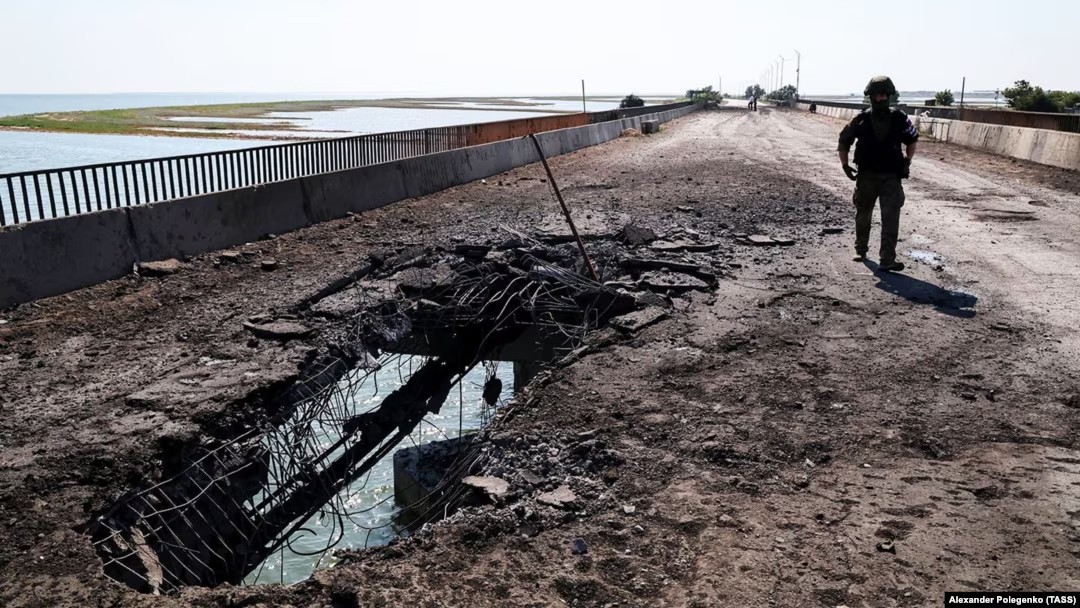
- The damage is structural this time. Satellite imagery by Schemes confirms damage at Chonhar; the regiment commander calls it critical to the load-bearing span, with all traffic stopped and Russia deploying pontoons.
- Russia pre-positioned its adaptation. Satellite images show a pontoon crossing first appeared at Chonhar in June 2023, then was stowed - the counter-move was ready years before this campaign.
Six hours. That's how long it took in June 2026 to go from intelligence - fuel convoys would cross the Chonhar bridge - to the strike that closed it, according to the commander of Ukraine's 1st Separate Assault Regiment, speaking to Suspilne on June 11. In 2023, hitting the same bridge required British cruise missiles, allied coordination, and weeks between strikes. The bridge is the same. The loop around it is not.
One bridge, two campaigns
Chonhar is the choke point of the southern war. The crossings over the Syvash connect occupied Crimea to the occupied left bank of Kherson region - one of two main supply routes feeding Russian forces in the south, alongside the coastal road through Armiansk.
The 2023 campaign against it reads like a calendar of scarce events. On June 22, 2023, Storm Shadow cruise missiles - confirmed by Ukraine's General Staff - holed the road bridge. UK Defence Intelligence assessed that Russian convoys then took at least 50 percent longer to reach the front from Crimea, and that Russia quickly threw a pontoon crossing alongside. On July 29, the railway bridge was hit. On August 6, the road bridge again, also with Storm Shadow per Ukrainian officials. Three strikes in seven weeks. Between them, Russia repaired, rerouted, and reopened. Each missile was an imported, politically negotiated, finite asset - and the strike tempo showed it.
The 2026 campaign reads like a schedule. Per statements by the Russian-installed Kherson administration and Ukrainian reporting: drones hit the Chonhar road bridge on the night of June 7, closing it. Traffic partially resumed June 8 in reverse-flow mode. Drones hit it again on June 9. On June 10, occupation authorities reported a strike on the Henichesk bridge to the Arabat Spit - the alternative route they had switched to. Overnight into June 11, the installed governor reported drone strikes on four more bridges: two over the North Crimean Canal near Preobrazhenka and Myrne, the road bridge on the Perekop-Armiansk axis, and a bridge near Stavky - while local channels reported hits in Armiansk and near Krasnoperekopsk inside Crimea itself. Four strike nights in five days, walking down the route map as Russian logistics tried to flow around each new blockage.
Satellite imagery published by Schemes (Radio Liberty) confirms structural damage at Chonhar; the assault regiment's commander called it critical to the span's load-bearing structure, with no truck or car traffic moving. Ukraine's Center for Countering Disinformation went further, calling the bridge destroyed - treat that as one side's framing until imagery settles it.
What actually changed
Not the target, and not the idea. Interdicting Crimea's land links has been Ukrainian doctrine since 2023. What changed is three parameters of the loop.
Tempo. In 2023, the decide-strike cycle ran through allied stockpiles and weeks of planning; in 2026, a regiment commander describes six hours from intelligence to impact for a time-sensitive target, and a pre-planned follow-on strike on the Armiansk axis ready when logistics shifted there. The adaptation window - the time Russia has to repair, reroute, or rebuild before the next hit - has collapsed from weeks to a single night.
Magazine depth. A campaign built on domestically produced strike drones is limited by production lines, not by another government's export decision. The cost asymmetry that The Loop has tracked at the tactical edge - cheap munition versus expensive target - has migrated to operational depth: a bridge span now sits on the wrong side of the same equation that FPVs imposed on armored vehicles.
Sovereignty of the cycle. Storm Shadow strikes carried an invisible approval layer. A drone campaign run on national production answers to national targeting alone. That changes not just speed but what can be targeted: a pontoon, a repair crew's progress, yesterday's detour.
The trade-off is honest physics. A Storm Shadow-class warhead is in the 450-kilogram class; strike drones carry a fraction of that. One missile could drop a span where a drone scars it. The 2026 answer to smaller warheads is repetition - which is exactly what cheap, sovereign munitions make affordable. Interdiction has shifted from an event to a subscription: the question is no longer whether the bridge can be hit, but whether it can ever stay open.
Where the loop turns next
Russia's counter-moves are already visible and already old: satellite imagery shows a pontoon crossing first appeared at Chonhar back in June 2023 and was later stowed - the adaptation was pre-positioned. Expect more pontoons, dispersed crossings, and - the move to watch - dedicated counter-drone umbrellas over the chokepoints: jamming corridors, interceptors, the sensor-plus-cheap-interceptor architectures that Russian engineering channels are now openly sketching for rear-area defense. DeepState analysts frame the bridge strikes as one component of a blockade of the occupied south, alongside drone units extending air control over sections of the land corridor; if that control thickens, pontoons become targets with the same subscription pricing as bridges.
What to watch: how long Chonhar traffic stays closed compared with the weeks-scale repairs of 2023; whether strikes keep walking deeper down the reroute map (Armiansk and Krasnoperekopsk already suggest yes); and whether dedicated counter-UAS assets appear at the crossings - the clearest signal that the loop has registered the new tempo and is answering it.
The Human Was in the Loop. The Verification Was Not.
The Constraint Is Not Units. It Is the Retool.