The Last Mile Is the Kill Zone: How Resupply Went Unmanned
Key facts
- The kill zone is 10-20 km deep. Through 2023-2024, the band behind the line where FPV drones reliably find and strike vehicles widened from a few kilometers to 10-20 km on both sides - turning the entire last stretch of any supply run into exposed ground.
- 50,000+ robot missions in five months. Ukraine's UGVs ran more than 50,000 logistics and evacuation missions from January to early June 2026, climbing monthly. Stated goal: move 100% of front-line logistics to uncrewed platforms.
- Two answers, opposite price tags. Ukraine's ground robot averages ~$11,000 and is reusable; the US Grasshopper glider costs under $40,000 and is expendable. Not competitors - two tools for the same dangerous mile.
- The glider's numbers. Grasshopper: up to 227 kg (500 lb) payload, ~176 km/h glide speed, range of "tens of miles" by release altitude, inertial navigation that works through GPS jamming. Several dozen delivered to the US Air Force since 2025.
- A longer-range variant is coming. The turbine-powered Long-Range Grasshopper (called Dragonfly in development - the same vehicle) tested in late 2024 with ~10x the range, same 500-lb payload, slated for service in early 2026.
A few hundred dollars. That's all it costs an enemy drone team to find a truck on a forest road and turn a routine supply run into a casualty report. In late May 2026, US Green Berets and allied troops dropped 500-pound autonomous cargo gliders from a Romanian transport plane over a range in North Macedonia - a NATO exercise built around a simple admission, stated plainly by one defense outlet covering it: three years of watching Russia and Ukraine fight has changed how the Pentagon thinks about resupply, because convoys get hit, helicopters get hit, and cheap drones find vehicles on roads. The most dangerous job in modern war is no longer always at the front. Increasingly, it is the drive to it.
This is a Field Report about the last mile - the final stretch of supply line where food, ammunition, batteries, and medical kits meet the people who need them. That mile has become a kill zone, and both the cheapest and the most advanced armies on earth are reaching the same conclusion: stop sending humans down it.
The number that reorganized logistics
The kill zone has a measurable depth, and it has been growing. Through 2023 and 2024, the band of ground behind the line of contact where vehicles can be reliably found and struck by FPV drones widened from a few kilometers to, by many front-line accounts, 10 to 20 kilometers on both sides. The mechanism is the cost asymmetry The Loop tracks everywhere: a drone costing a few hundred dollars destroys a truck worth a hundred times more, and - the part that reorganizes armies - kills or wounds the people in it.
Once that band exists, the arithmetic of supply changes. A driver running ammunition forward is no longer exposed only at the front; he is exposed for the entire final stretch. Casualty data has followed the logic. Russian and Ukrainian reporting alike now describes resupply, evacuation, and rotation along these routes as among the deadliest tasks of the war - not the assault itself, but getting to and from it. When the act of carrying a box becomes as lethal as fighting, logistics stops being a support function and becomes the problem to solve.
Two solutions emerged, from opposite ends of the cost spectrum, aimed at the same mile.
Solution one: the cheap robot on the ground
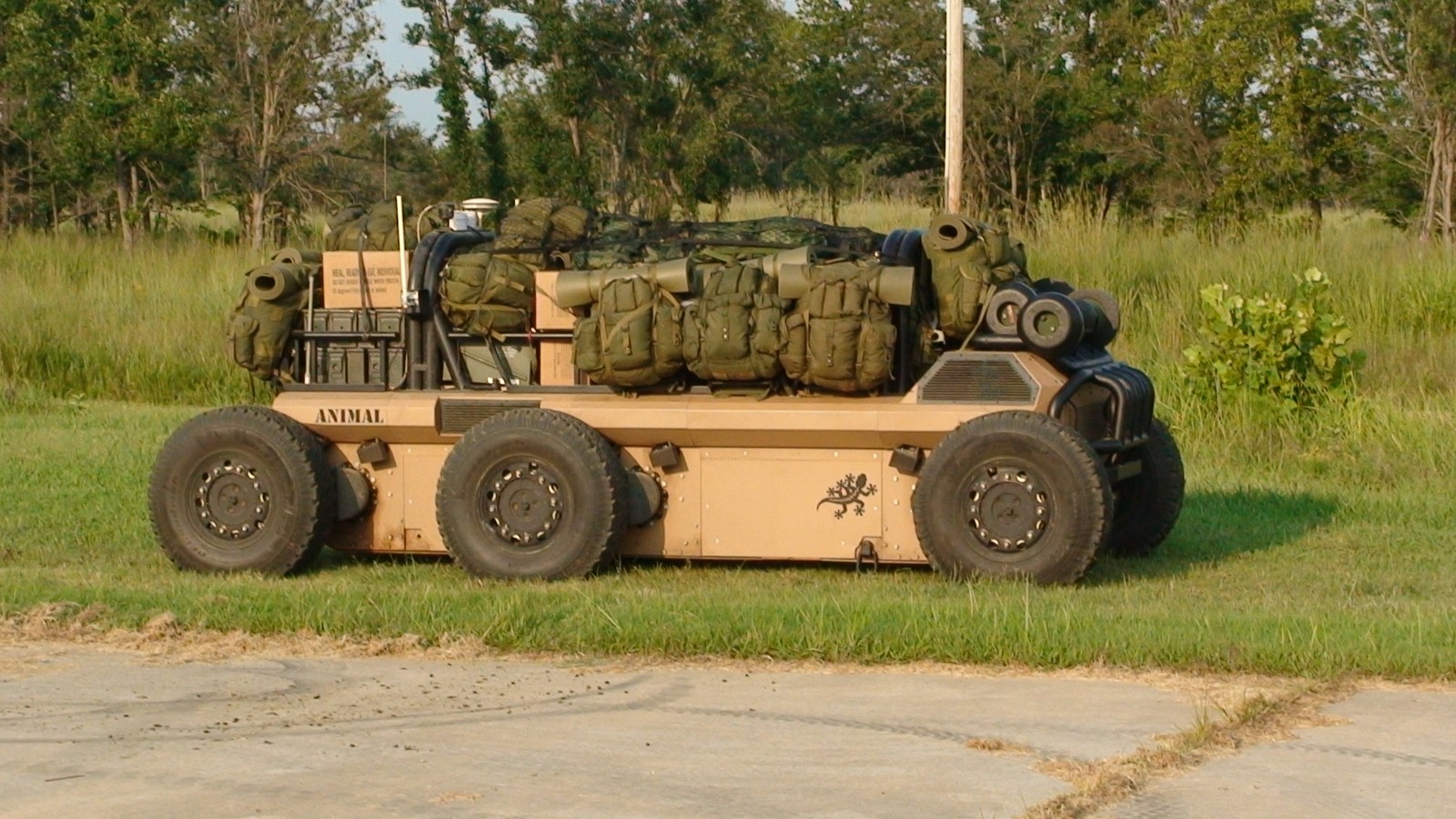
Ukraine's answer came from below, in volume. Uncrewed ground vehicles - tracked and wheeled robots that carry supplies forward and bring casualties back - went from a niche experiment to an industrial category in eighteen months. Ukraine's Defense Ministry reports UGVs ran more than 50,000 logistics and evacuation missions between January and early June 2026, climbing month over month, and has set a target of moving the entire front-line logistics chain to uncrewed platforms. The average machine on the ministry's procurement marketplace runs around $11,000 (our figure, derived from official totals). The trade-off is honest: a ground robot is slow, bound to terrain, vulnerable to mud and mines, and must survive an electronic-warfare environment for hours. But every mission it runs is a supply or evacuation run that no human had to drive.
Solution two: the expendable glider from the sky
The American answer came from above, and from a different budget line. The Grasshopper, built by California firm DZYNE Technologies and fielded to the US Air Force in 2025, is an expendable autonomous glider: launched from a transport aircraft well outside a threat zone, it unfolds its wings, navigates itself to coordinates, and lands its cargo under a parachute. Its published numbers: up to 227 kilograms (500 pounds) of payload, a glide speed around 176 km/h, a range of "tens of miles" depending on release altitude, and a unit cost the manufacturer keeps below $40,000. Crucially, its inertial navigation lets it work through GPS jamming - the same contested-spectrum problem the ground robots face, solved in the air. Several dozen have been delivered. A turbine-powered variant - marketed as the Long-Range Grasshopper, the same vehicle AFRL called Dragonfly in development - tested in late 2024 with roughly ten times the range, slated to enter service in early 2026.
Note the difference in philosophy. The glider is expendable but expensive at $40,000; the ground robot is recoverable but cheap at $11,000. One trades altitude and standoff for a single use; the other trades speed for reusability. They are not competitors. They are two tools for the same mile, suited to different armies, distances, and threats.
What the two have in common
Strip away the price tags and the solutions are the same idea: remove the human from the dangerous transit, and accept autonomy as the cost of doing so. Both rely on self-navigation that survives jamming - inertial systems in the glider, multi-channel comms in the robots. Both are explicitly framed by their makers and users as ways to keep people out of harm's way. And both convert a problem that used to be solved with courage - a driver volunteering for a bad road - into a problem solved with hardware.
That conversion is the quiet revolution. For most of military history, logistics under fire was a test of nerve. The new answer is to make the carrier unmanned and, ideally, cheap enough that losing it is an accounting entry rather than a funeral.
Where this sits in the loop
This is adaptation, not endpoint, and the counter-move is already visible. An expendable glider gliding silently to coordinates is a low-signature target today - but the same sensor-and-interceptor architectures now being sketched for rear-area air defense (cheap acoustic detection, AI-cued interceptors) are exactly what would hunt slow cargo platforms tomorrow. A ground robot is invulnerable to the rifleman but not to the FPV that costs a fraction of it; an enemy trading $500 drones for $11,000 robots will take that exchange all day, pushing ground logistics toward the same attrition economics that consumed armored vehicles.
The deeper pattern: as the kill zone swallowed human logistics, it pushed the carrier into the air and onto autonomous wheels - and the kill zone will follow. The next contest is not whether resupply goes unmanned. That is settled. It is whether the unmanned carrier can be made cheaper, faster, and harder to detect than the thing built to kill it.
What to watch
Three indicators. First, cost trajectory: whether the expendable glider gets cheaper (the $40,000 line is high for true attritability) and whether the ground robot's ~$11,000 average holds as volume scales. Second, the counter: the first confirmed footage of a dedicated intercept of a cargo glider or a systematic FPV campaign against logistics robots - the moment the loop visibly closes on resupply. Third, doctrine transfer: whether the American expendable-glider concept and the Ukrainian volume-UGV concept begin borrowing from each other, the clearest sign that two armies have recognized they are solving one problem.