The End of Distance: How 500 Kilometers Stopped Being Protection
Key facts
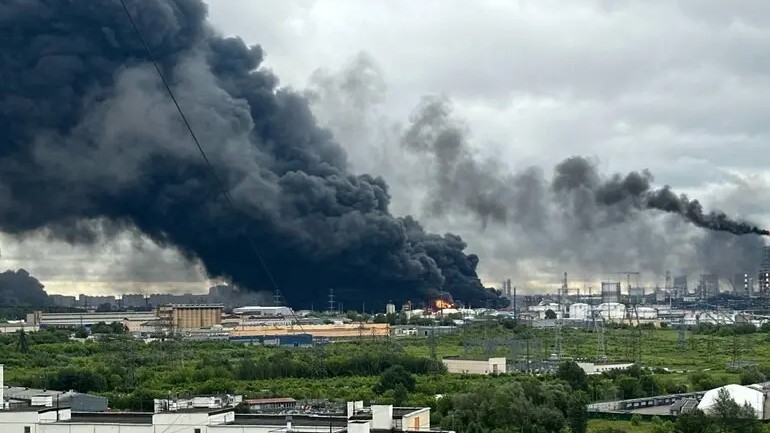
- 500 km, nine miles from the Kremlin. On June 18, 2026, drones that crossed 500 km of Russian airspace set fire to the Moscow refinery - which supplies over a third of the capital region's fuel - for the third time in one campaign.
- The night's drone counts are unverified. Russia claimed ~190-200 downed near Moscow and 500+ countrywide; the mayor called it the city's largest attack. These are one side's claims - there was no neutral tally.
- The verifiable trend: refineries hit doubled this year. Independent reporting, not battlefield claims, anchors the story: Reuters says the number of Russian refineries struck doubled since January; the IEA expects throughput suppressed into mid-2026; ~2/3 of major refineries hit since 2022.
- Repetition is the method. The same plants are hit weeks apart - struck, nearly repaired, struck again; one southern refinery reportedly targeted 16 times. A single strike is an event; a schedule of strikes keeps a refinery offline.
- Serious, not decisive. The widely cited "38% of capacity lost" is the upper bound - the combined capacity of every refinery hit over a period, not the share offline at once. Russian plants carry surplus capacity and recover partial output in weeks. Real reading: sustained pressure drawing down slack, not collapse.
Nine miles from the Kremlin. That is how close the Moscow refinery is to the seat of Russian power, and on June 18, 2026, it burned for the third time in a single campaign. Ukrainian drones that had crossed 500 kilometers of Russian airspace set fire to a plant that, by its own corporate account, supplies more than a third of the capital region's fuel. The number worth holding onto is not how many drones flew - the two sides give figures that cannot be reconciled - but how far they flew, and how routine the distance has become.
This Field Report is about that distance, and the slow collapse of an idea Russia built its war on: that depth is safety. For most of the full-scale invasion, the interior was a sanctuary. Factories, refineries, and the capital itself sat behind a wall of geography. That wall is now porous, and the erosion is measurable.
The trend behind the night
A single night's tally is the wrong unit of analysis, because the numbers are contested and the event is not the point. Russia's Defence Ministry claimed nearly 200 drones downed on Moscow's approaches and over 500 across the country; Moscow's mayor reported the attack was the largest the city had faced. Treat both as what they are - claims from one side, useful as a floor and a direction, not as a verified count. There was no neutral tally, and there rarely is.
What is verifiable is the trend the night sits inside, and here independent sources converge. Reuters reported in late May 2026 that the number of Russian refineries hit by Ukrainian drones had doubled since the start of the year. The International Energy Agency assessed the strikes would suppress Russian refinery throughput into at least mid-2026. Independent analysts cited across Western coverage estimate the campaign has knocked out somewhere between 10 and a quarter of Russia's refining capacity, with the higher figures disputed (more on that below). Since 2022, by multiple counts, Ukrainian drones have struck roughly two-thirds of Russia's major refineries. The Moscow strike is one data point on a line that has been climbing for eighteen months.
Crucially, the depth has grown with the volume. Where light drones once reached only refineries near the border - Krasnodar, Rostov - the campaign now regularly touches plants near Moscow, in the Volga region, and 1,500 kilometers into Russian territory by some accounts. The map of what can be hit has expanded outward, and the capital is now inside it.
Why refineries, and why the same ones twice
The target set is not random, and reading it explains the doctrine. Refineries are chosen because they sit at the intersection of three things Russia cannot easily move: war-fuel for the front, civilian fuel for domestic stability, and export revenue for the budget. A burning distillation column degrades all three at once.
The second pattern is more telling than the first: the same plants are hit repeatedly, weeks apart. Open-source analysis has documented refineries struck, nearly repaired, then struck again - one southern plant has reportedly been targeted more than a dozen times. This is the deliberate logic The Loop tracks everywhere: against a target that can be repaired, a single strike is an event, but a schedule of strikes is a condition. Repetition converts a refinery from a thing you damage into a thing you keep offline. It is the same shift from event to subscription that has reorganized bridge interdiction and logistics - applied here to the energy economy.
The honest accounting: serious, not decisive
Here the editorial discipline matters, because the temptation is to read fire as collapse. It is not.
The damage is real and economically significant. Reuters tallied plants representing a substantial share of Russian gasoline and diesel output as offline or reduced at the campaign's peak; the IEA embedded a more cautious outlook for Russian refining; Russia has imposed gasoline export bans and seen domestic shortages and rationing. These are not nothing. They are, in the words of one energy analyst, the beginning of the exhaustion of Russia's refining potential.
But the ceiling is lower than the loudest figures suggest, and the correction comes from analysts sympathetic to neither narrative. The Carnegie assessment is the clearest: the widely cited "38 percent" is the combined capacity of every refinery hit over a period, not the share simultaneously offline - an upper bound, not a state of affairs. Russian refineries carry surplus primary distillation capacity and tend to recover partial output within weeks; damage to one distillation column more often means a 30 percent drop in a plant's gasoline output than a total stoppage. Russia operates the world's third-largest refining system. The realistic reading: a fuel sector under sustained, painful pressure that is drawing down its slack - not one in collapse. Anyone telling you Moscow is about to run dry is selling a story the data does not support.
Where this sits in the loop
The erosion of sanctuary is itself an adaptation, and it has already prompted a counter-move - which is the real reason this strike matters to The Loop's beat. Reporting before June 18 described armed personnel on hydraulic lifts appearing around Moscow, positioned to engage drones over the city: improvised point defense for a capital that did not expect to need it. That is the loop turning. The next stage is legible in the concept papers Russian engineering channels are already publishing - the cheap-acoustic-sensor-plus-interceptor architectures we have covered, explicitly framed as rear-area defense. Moscow is now the rear that needs defending, and the proposals know it.
The deeper pattern is the one this whole publication exists to track: the same cost asymmetry that emptied the front-line road of human logistics is now reaching into the strategic interior. A long-range strike drone reportedly costs in the tens of thousands of dollars; the refinery throughput it suppresses, and the air defense it forces a country to build over its own capital, cost vastly more. Depth used to convert into safety automatically. It no longer does, and the price of buying that safety back - interceptors, jamming, lifts with riflemen over the city - is now a line item in Russia's war.
What to watch
Three indicators, none of them tonight's body count. First, repair tempo versus strike tempo: whether the gap between hits on a given refinery keeps shrinking faster than Russia can restore throughput - the metric that decides whether damage is temporary or systemic. Second, the defensive build-out: whether improvised measures over Moscow harden into the dedicated sensor-and-interceptor systems now being sketched, the clearest sign the loop has registered the threat. Third, the export data, not the fire footage: whether Russian refined-product exports and domestic fuel availability show sustained decline in independent figures (IEA, Reuters), which is where this campaign will be won or lost - far from the cameras.